Software without developers
Your own software team, ready when you ask.
Plantable gives your business a team of agents: a lead, developers and a reviewer. They build what the business needs in real code, on your own data, and ask you only about the business. You decide what reaches your team.
- No one to recruit
- No quote for each change
- The code is yours
Software team · Fernwood Gardens
Example
- DoneDeveloperBuilt the quote formDone
- WorkingDeveloperBuilds the auto-replyWorking
- NextReviewerChecks the whole changeNext


The usual way
With a developer, each small change is a project.
One more question on a form should take one sentence. Through an agency or a freelancer, it takes a brief, a quote, a wait and an invoice. So small changes wait, and the team works around them.
A developer or an agency
- Write a brief
- Wait for a quote
- Approve the quote
- Wait for a free slot
- Test it yourself
- Pay the invoice
Often weeks, and an invoice for each change.
PlantableLive
- Ask in plain words
- Try it on a copy of your data
- Release it
No brief and no quote. The team starts on it within a minute.
- Hiring takes months.
- A good developer is hard to find, and a salary is hard to carry for a business of a few people.
- One person holds the keys.
- The code, the passwords and the know-how sit with one person. When that person leaves, the business starts again.
- You cannot check the work.
- Without a technical person, it is hard to tell good work from bad, or a fair quote from a high one.
- An AI app builder makes you the developer.
- It is quick to start. Then you explain, test and fix each app, and each one stands alone, away from your data.
Meet the team
A whole software team, from the first day.
Each agent has one job, as on a good team of developers. They work in the background, at any hour, and come to you only when the business must decide.
- A1
Plans the work
Lead
Turns what you ask into a plan, splits it for the developers, and decides on each result. When something is unclear, the lead asks you.
- B1
Build it
Developers
Each developer builds one piece of the plan in real code, then checks its own work. Several work at the same time.
- C1
Checks it
Reviewer
Reads the whole change with fresh eyes, for mistakes, security and design, before you see it.
- D1
Makes the team better
Coach
After each release, finds where the team lost time, and files the fixes.

Decide
You
Say what the business needs, answer the questions only you can answer, then release each change to your team, or send it back.
Tests guard each change.
A change must pass its tests before it goes further. When a test fails, the developer fixes the change.
No black box
See each step of the work, and what it cost.
With a developer, you see the invoice at the end. With Plantable, you see the work while it happens, and the cost of each part.
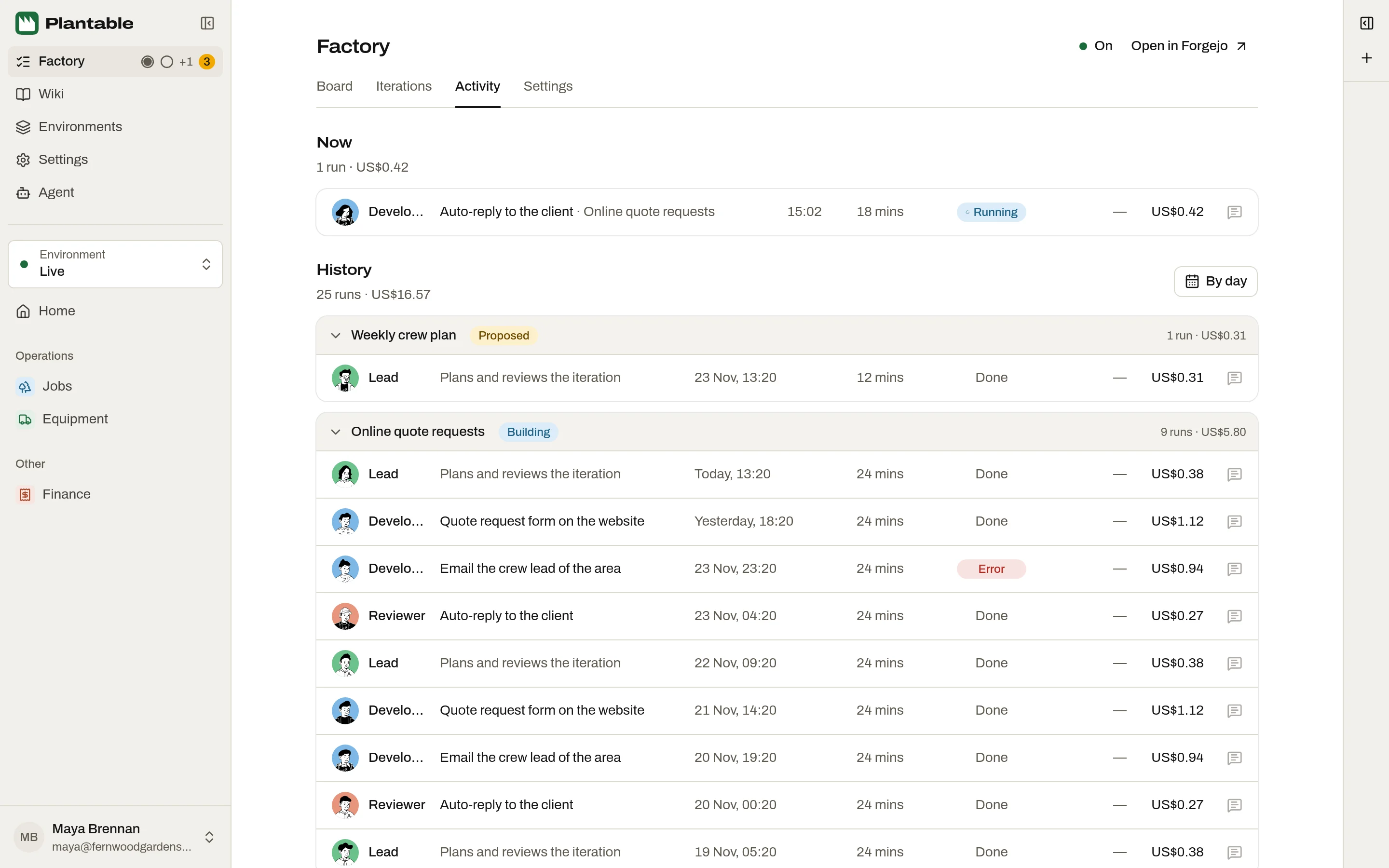
The board
What is planned, what is in progress, and what waits for you: a plan to approve, a question to answer, a change to try.
Activity
Each run of each agent: who worked, on what, for how long, and what it cost.
Budgets
Set a limit on the spend. At the limit, the team waits for the next reset. Pause it at any time.
A morning email
Each morning, each person who has something to decide gets one email with all of it.
It knows your business
It learns your business once, and it never leaves.
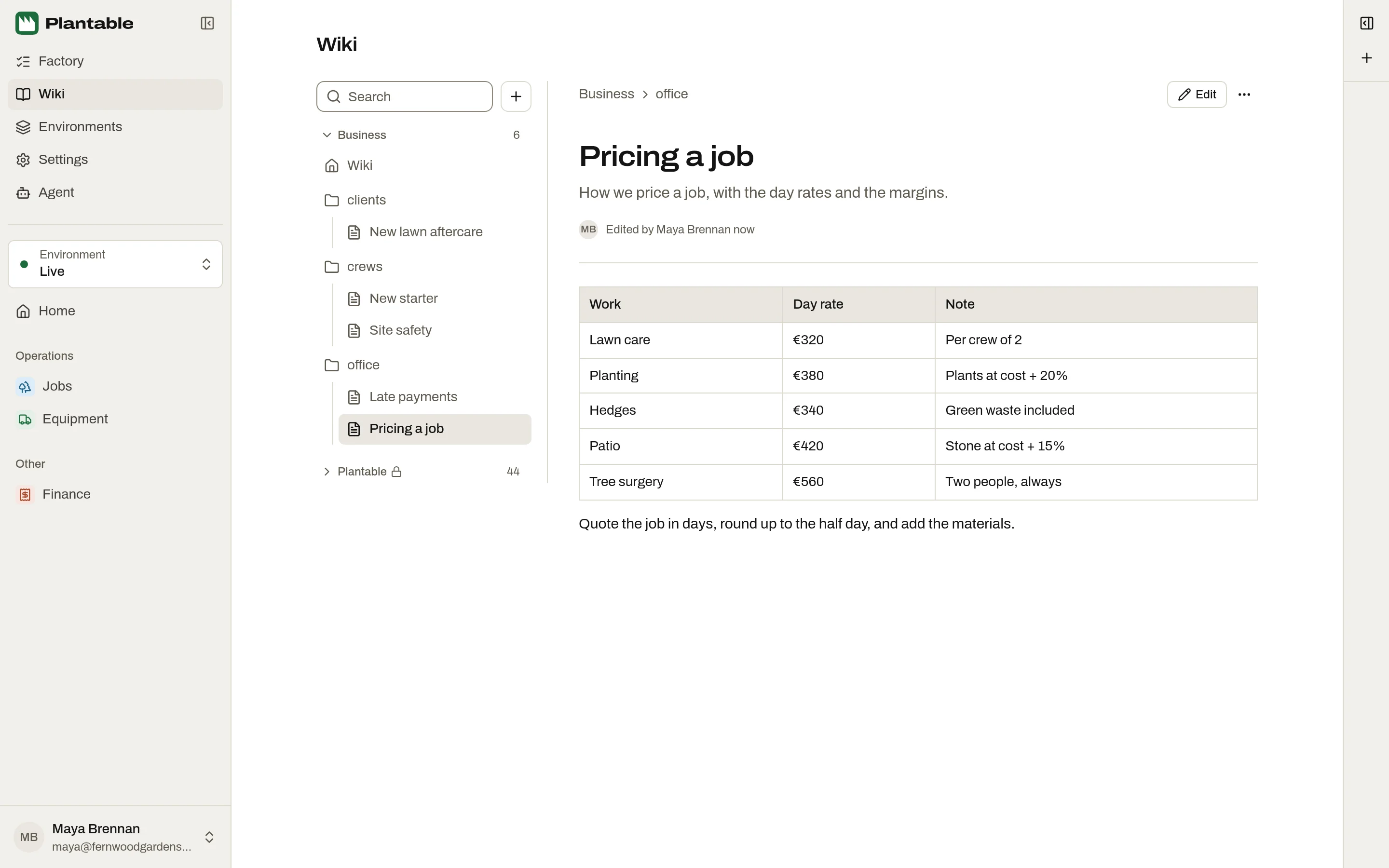
A new developer takes months to learn how a business works, and takes it all with them when they go. The agents read it from your own wiki, and keep what you teach them.
- Your wiki
- Prices, rules and who does what, in plain pages that your team writes and each agent reads.
- What you teach it
- Tell the agent the same thing twice, and it keeps it as a memory for each chat after.
- Documents with each change
- Each app has its documents in your repository. Each change updates them, and the review checks that it did.
You stay in charge
The agents do the work. You keep the keys.
A team that you do not manage still needs rules. These rules are in the platform itself, so no agent can talk its way around them.
The agents
Only a person
Each change stops at the release, until a person lets it through.
The agents
- Plan, build, review and test each change
- Work on a copy of your real data, never on the live business
- Ask before they build, when the business must decide
- Stop at the budget that you set
Only a person
- Releases a change to the team. Only an approver can, after a recent sign-in.
- Sends a change back with what to change
- Approves a plan before work starts, if you want to
- Sets the budget, pauses the team, and chooses who sees what
How often a plan waits for you
An approval never releases a change. A person tries it first.
- Always ask
- Ask when needed
- Never ask
Real code
Real software, not a no-code workaround.
The agents write code, as developers do. So there is no limit of a builder to hit, and nothing is locked in a tool.
- Yours, in git
- The code of each app is in the git repository of your business. Take it with you at any time.
- Your data in Postgres
- A standard database that any developer or tool can read. Export it at any time.
- Ready for a developer
- If you hire a developer one day, they start from real code and its documents, not from zero.
- AGENTS.mdHow the agents work here
- apps/quote-formQuote request form
- apps/invoice-remindersOverdue invoice reminders
- docs/specA document for each app
- migrationsEach change to the data
- testsTests that each change passes
The demo
Bring the quote a developer gave you.
Or just a list of what you need. We go through it with you, show what the team would build first, and what it would cost next to the quote.
If a developer is the better choice for you, we say so.
Book a demo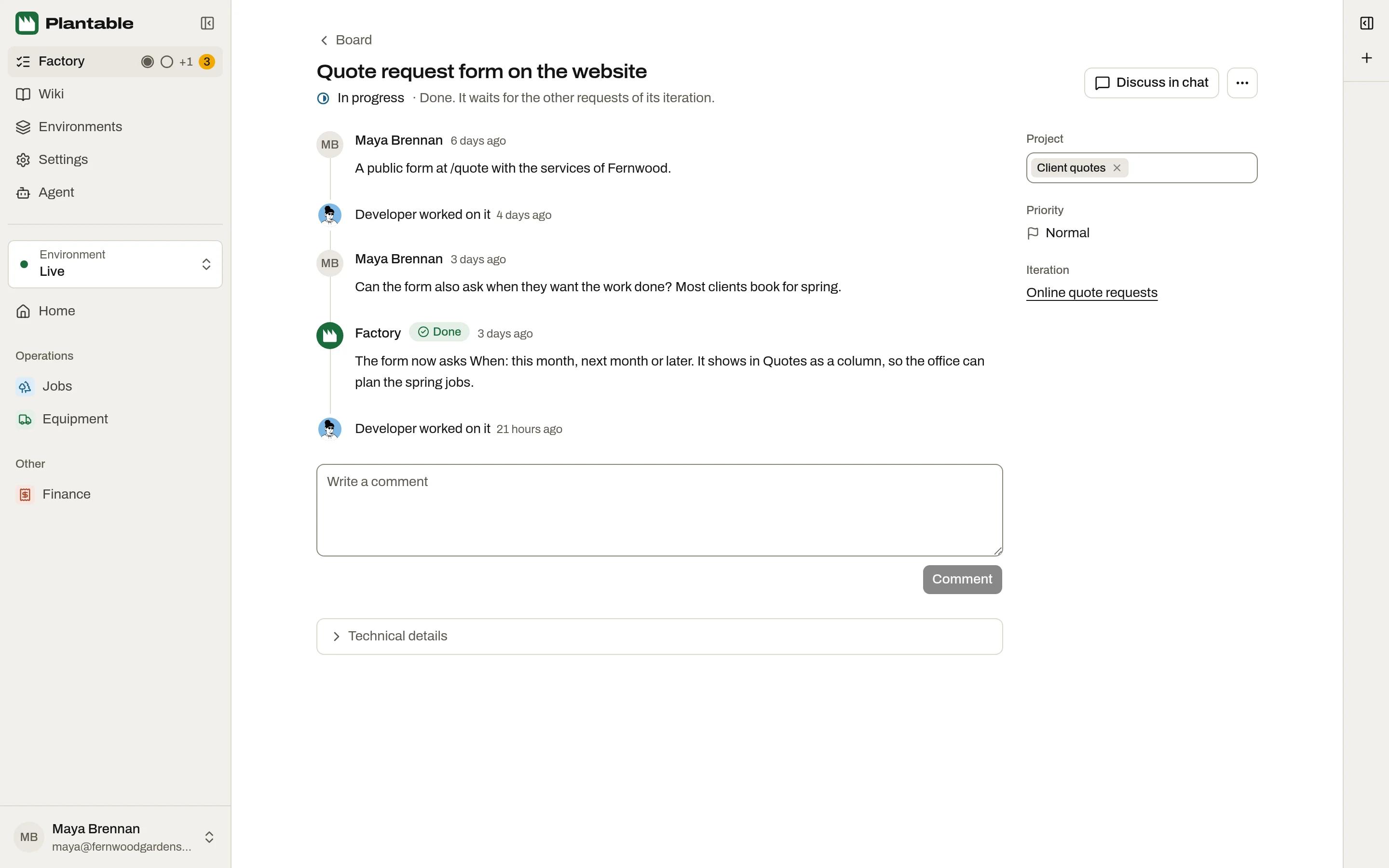
Questions
Before you hire anyone.
What owners ask us when they compare Plantable with a developer.
Do I need to know anything about code?
No. You talk about the business: what it needs and how it works. The agents ask about the business, never about code.
Who fixes it when something breaks?
The same team. Fixes of errors, updates and security fixes go into a Maintenance project, and the agents do them as any other request. You try each fix before your team gets it.
What if it builds the wrong thing?
Nothing reaches your team until a person tries it on a copy of your data and releases it. If it is not right, send it back with what to change.
What can it build?
The software a small business runs on: forms, sheets, workflows, bookings, client portals, emails, reports and pages of your website. Accounting, payroll, payments and banking stay with the tools made for them, and the agents connect your apps to them.
We already have a developer. Is it for us?
Yes, it can work beside them. Your developer can read each change in git, give the routine work to the agents, and keep the hard parts.
What happens if we leave Plantable?
The apps leave with you. The code is in git and the data is in Postgres. Run it yourself, or hand it to any developer.
How much does it cost?
It depends on the work you ask for. You see the cost of each run of each agent, and budgets cap the spend. In the demo, we put it next to the quote of a developer or an agency.
Book a demo
What would you ask a developer to build?
Book a demo, and bring it. We show you the team at work on a business like yours, and what it would build first for you.